
Patch Cable vs. Crossover Cable Key Differences Explained
When setting up a network, choosing the right Ethernet cable is essential for ensuring smooth connectivity. Two of the most common options are the patch cable and the crossover cable. Although they may look similar, they serve very different purposes. So, what is the difference between patch cable vs. crossover cable? Let’s break down the details.
T-568A vs. T-568B Standards
Before comparing patch cables and crossover cables, it’s important to understand the T-568A and T-568B wiring standards. These standards define how the wires inside an Ethernet cable are arranged when terminated with RJ-45 connectors.
While both follow the same color-coded scheme, the sequence of the color pairs differs. This difference in wiring standards is the foundation for how patch cables and crossover cables are built.
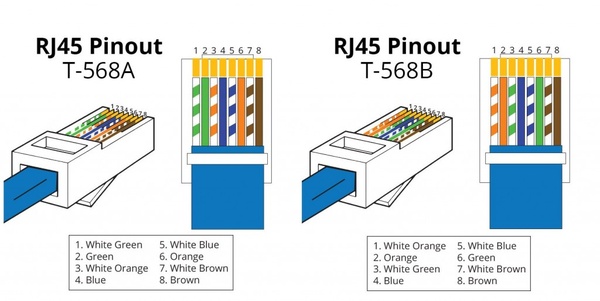
What Is a Patch Cable?
A patch cable, also called a straight-through cable, is a twisted pair Ethernet cable where both ends follow the same wiring standard—either T-568A to T-568A or T-568B to T-568B. This means the pin assignments on both ends match.
Common uses of a straight-through patch cable include:
-
Connecting a computer to a switch
-
Connecting a router to a hub
-
Linking a LAN port to a switch or computer
What Is a Crossover Cable?
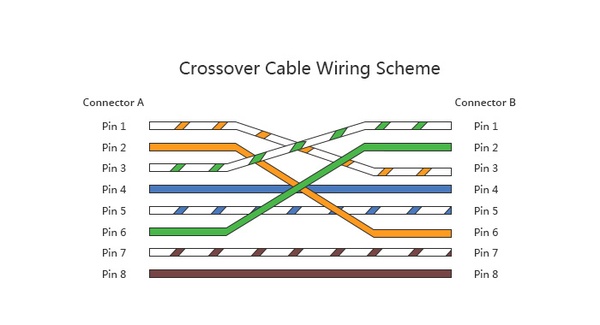
A crossover cable is different. Instead of using the same wiring standard on both ends, one side uses T-568A and the other uses T-568B. This design “crosses” the transmit (TX) and receive (RX) signals, allowing two similar devices to communicate directly without interference.

Typical applications of a crossover cable include:
-
Connecting PC to PC
-
Linking switch to switch
-
Connecting router to router
-
Linking hub to hub
Patch Cable vs. Crossover Cable: Practical Differences
The key difference lies in their wiring and use cases:
-
Patch cables have identical wiring at both ends and are used to connect different devices.
-
Crossover cables have different wiring on each end and are used to connect similar devices.
-

Patch Cable vs. Crossover Cable Key Differences Explained
Scenario 1: PC to PC
If two computers are connected directly using a patch cable, their TX signals will collide, and no data will be exchanged. In this case, a crossover cable is required so that one PC’s TX wire connects to the other PC’s RX wire.
Scenario 2: PC to Switch to PC
When a switch is placed between two PCs, the switch itself handles the crossing. Therefore, a simple patch cable (such as Cat5e patch cable or Cat6 patch cable) is enough to complete the connection.
Scenario 3: PC to Switch to Switch to PC
When multiple switches are involved, the rules change:
-
PC to Switch → needs a patch cable
-
Switch to Switch → requires a crossover cable
-
Switch to PC → needs a patch cable
-

Patch Cable vs. Crossover Cable Key Differences Explained
Conclusion
In summary, patch cords and crossover cables look alike but differ in wiring standards and applications. Understanding when to use each type ensures stable, reliable, and efficient network performance. By identifying whether you need to connect similar devices or different devices, you can easily choose between a patch cable and a crossover cable for your setup.
We are a professional manufacturer specializing in fiber optics and optical cables, including indoor cables, outdoor cables, non-metallic cables, flame-retardant cables, tube-bundled cables, ribbon cables, data center cables, submarine cables, underwater cables, optoelectronic composite cables, base station field cables, drone cables, and sensing detection cables. Our fiber optic cables are competitively priced. We also supply 568A and 568B network cables with volume discounts available. Inquiries are welcome.
Some of the pictures in the article are from the Internet