
LC Fiber Optics A Complete Guide
In modern fiber optic cabling, LC fiber connectors have become one of the most widely used and recognized solutions. Known as the most successful representative of the Small Form Factor (SFF) connector, the LC connector family has grown to include LC fiber connectors, LC fiber patch cables, LC adapters, LC patch panels, and many other LC fiber assemblies. Because of their compact design and reliable performance, LC fiber optics are now the backbone of LAN networks, data centers, and telecommunication infrastructures.
This article provides a detailed overview of LC fiber optics, explaining what LC means, its core features, and the wide range of LC fiber optic solutions available for different applications.

What Does LC Mean in Fiber Optics?
The abbreviation LC stands for Lucent Connector. It was originally developed by Lucent Technologies (now Alcatel-Lucent) to support the growing demand for telecommunications and high-performance networking. The LC connector uses a reliable retaining tab mechanism that makes it easy to plug in and remove. Its body resembles the well-known SC connector, but the LC connector is only half the size, making it ideal for high-density fiber installations.
Like the SC type, the LC fiber connector follows TIA/EIA 604 standards, ensuring precise alignment and secure connectivity. Thanks to its space-saving design and outstanding performance, the LC connector quickly became one of the most popular interfaces in the fiber optic industry, and it continues to dominate fiber optic cabling systems today.

What Are the Features of LC Connectors?
One of the main reasons LC connectors maintain their popularity is their combination of compact size, reliable performance, and ease of use. While manufacturers may design slightly different versions, most LC fiber connectors share these common features:
-
Small Form Factor (SFF): The LC connector is only half the size of traditional connectors such as SC, FC, or ST connectors. This miniature size enables efficient use of rack space in data centers and supports high-density cabling.
-
Low Insertion Loss: With a six-position tuning feature, LC connectors ensure precise alignment of fiber cores, reducing insertion loss and improving transmission quality.
-
Flexible Assembly Options: LC fiber connectors are available as one-piece pre-assembled units for faster field installation, or as multi-piece designs more suitable for factory assembly.
-
Ease of Use: The design makes it simple to connect and disconnect while maintaining excellent mechanical stability, supporting long-term durability in fiber optic networks.
Thanks to these advantages, the LC connector has become the preferred choice for a wide variety of fiber optic solutions, from enterprise LAN systems to carrier-grade networks.

LC Fiber Optic Solutions
Over the years, a broad range of LC fiber optic solutions has been developed to support different applications in telecommunications, enterprise networks, and data centers. These include LC fiber connectors, LC fiber patch cables, LC adapters, LC patch panels, LC attenuators, and many other LC-interfaced products. Each type plays a unique role in ensuring reliable, high-density, and cost-effective fiber optic cabling.
LC Fiber Connector Solutions
There are two main categories of LC fiber connectors:
-
LC connectors for jumpers – These are designed to mount onto fiber cordage of different diameters. For example, LC 1.5–2.0mm connectors fit 1.5–2.0mm fiber cords, while LC 3.0mm connectors are built for 3.0mm cordage. Both simplex and duplex LC connectors are available depending on the application.
-
LC BTW connectors – The “Behind-The-Wall” (BTW) type is a shortened version designed specifically for 0.9mm buffered fiber. These compact connectors are usually installed on the rear side of equipment. A common version is the LC BTW unibody connector, which offers increased stability and easy handling
LC Fiber Patch Cable Solutions
Among the most widely used products in fiber optic cabling are LC fiber patch cables, available in several variations:
-
Standard LC fiber patch cable – This common type features two LC connectors at both ends. They are available in single mode (OS1/OS2) and multimode (OM1/OM2/OM3/OM4/OM5), as well as simplex and duplex forms. Their compact size and stable performance make them a preferred choice in the fiber optic industry.
-
Uniboot LC fiber patch cable – Designed for high-density data centers, this cable houses two LC connectors within a single housing and shares one boot. By reducing the number of cables by up to 50%, it saves space and simplifies cable management. Advanced versions with a push-pull tab further improve accessibility and density.
-
Ultra low loss LC fiber patch cable – These cables offer exceptional performance with insertion loss as low as 0.12 dB, compared to the standard 0.3 dB. Built with rugged single-piece connectors, they minimize error codes and ensure reliable high-speed transmission for both single mode and multimode applications.
-
Armored LC fiber patch cable – Featuring strong armored fiber construction, these cables protect against crushing, twisting, or rodent bites while retaining flexibility. Despite their durability, the diameter is similar to standard LC cables, saving rack and conduit space.
-
Mode-conditioning LC patch cable – A hybrid solution combining single mode and multimode fiber within a duplex LC patch cord. It is particularly useful for long-wavelength Gigabit Ethernet applications where a standard multimode LC cord cannot be directly connected to certain 1G/10G optical modules.
-
LC breakout fiber patch cable – Also called fan-out cable, it contains multiple fibers with individual jackets inside a common outer jacket. One type has LC connectors on both ends, while another uses mixed connectors such as LC-MTP®, LC-MPO, LC-SC, LC-FC, or LC-ST. Breakout cables are essential in data centers and large telecommunication networks.
LC Fiber Adapter and Patch Panel Solutions
LC adapters (also called LC couplers) are designed to align and connect two LC fiber connectors. They are available in single mode and multimode, with simplex and duplex options. The self-adjusting design allows them to fit into patch panels with thicknesses ranging from 1.55 to 1.75 mm.
LC fiber patch panels serve as central distribution points in data centers and telecom rooms. They are available in multiple rack sizes such as 1U, 2U, and more, with port counts ranging from 12 to over 72. Panels may come pre-loaded with LC adapters or provided empty for customized configurations. Their modular design makes them ideal for managing high-density fiber optic cabling efficiently.

LC Fiber Attenuator Solutions
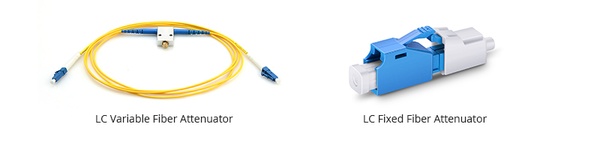
LC fiber attenuators are passive devices used to reduce optical signal power in networks, especially where erbium-doped amplifiers are deployed. They are critical for preventing overloading in optical systems while maintaining signal integrity.
-
Fixed LC attenuators – These provide a constant attenuation level, for example, a 1dB LC fiber attenuator reduces the signal by exactly 1dB.
-
Variable LC attenuators – These allow adjustment of the optical power level depending on system requirements, offering flexibility in fiber optic networks.
LC fiber attenuators are widely used in telecommunication networks, data centers, and high-performance LANs, ensuring optimal signal levels and reducing potential errors.

Other LC-Interfaced Product Solutions
Beyond connectors, patch cables, adapters, and patch panels, several other LC-interfaced products are available to support modern fiber optic cabling systems:
MTP®/MPO to LC Fiber Cassettes
MTP®/MPO to LC fiber cassettes are modular, pre-terminated units that mount directly on a fiber rack. They provide a smooth transition from backbone MTP®/MPO cabling to front-end LC connections. LC patch cords connect devices to the cassette front, while MTP®/MPO cables handle high-density backbone connections at the rear. These cassettes simplify network upgrades and minimize downtime.
LC-Interfaced Transceiver Modules
LC transceiver modules rely on LC interfaces to connect with LC fiber patch cables. Common types include:
-
SFP optical transceivers
-
10G SFP+ transceivers
-
25G SFP28 transceivers
-
40G QSFP+ transceivers
-
100G QSFP28 transceivers
-
400G QSFP-DD transceivers (including 400GBASE-FR4 and 400GBASE-LR8)
These transceivers support simplex or duplex connections and cover speeds from 1G up to 400G, providing high-performance solutions for modern data centers and enterprise networks.
LC Fiber Media Converters
LC media converters enable seamless conversion between different media types:
-
Copper to fiber converters – Allow traditional copper cabling to interface with fiber optic networks.
-
Fiber to fiber converters – Enable multimode-to-single-mode or dual-fiber-to-single-fiber transitions.
Many media converters support various interface types, including LC, ST, SC, MT-RJ, and RJ45. When using LC interfaces, they can connect directly with LC fiber patch cables, simplifying installation and ensuring reliable network performance.

Conclusion
The LC connector remains a widely recognized standard in fiber optics due to its compact size, reliability, and versatility. LC fiber optic solutions include a comprehensive range of products: LC connectors, LC fiber patch cables, LC adapters, LC patch panels, LC attenuators, as well as other LC-interfaced products like MTP®/MPO to LC cassettes, LC transceiver modules, and LC fiber media converters.
These solutions provide efficient, high-density, and stable connectivity for data centers, telecommunication networks, and enterprise LANs, meeting the demands of modern network environments and enhancing overall network performance and reliability.
We are a professional manufacturer specializing in fiber optics and optical cables, including indoor cables, outdoor cables, non-metallic cables, flame-retardant cables, tube-bundled cables, ribbon cables, data center cables, submarine cables, underwater cables, optoelectronic composite cables, base station field cables, drone cables, and sensing cables. Our optical cables are competitively priced. We also manufacture fiber optic accessories such as fiber optic patch cords, fiber optic adapters, and fiber optic splitters. Volume discounts are available. Inquiries are welcome. Fiber Optic Manufacturers
Some of the pictures in the article are from the Internet