
Multimode Fiber Types OM1 vs OM2 vs OM3 vs OM4 vs OM5
Multimode fiber is widely adopted for achieving 10Gbps Ethernet speed across short to medium distances in enterprise networks and data centers. Several multimode fiber types exist, each designed with different core sizes, bandwidth, and transmission distances. With options like OM1, OM2, OM3, OM4, and OM5, choosing the right fiber can be confusing. This guide explains the differences and helps you decide which one fits your network.
What Is Multimode Fiber?
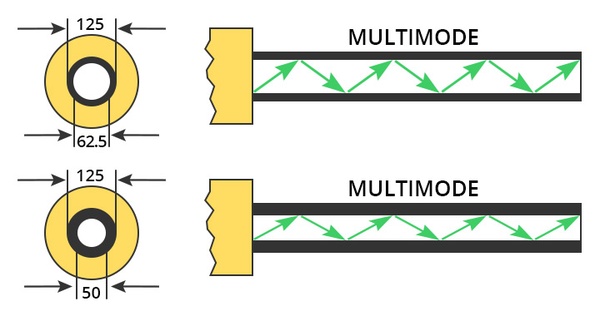
Multimode fiber (MMF) is an optical fiber cable commonly used for short-distance communication, such as inside office buildings or across campus networks. Featuring a larger fiber core (typically 50µm or 62.5µm), MMF allows multiple light modes to travel simultaneously, enabling higher data throughput. At 10Gbps, its maximum transmission distance is about 550m, while at lower data rates (e.g., 100Mb/s), it can reach up to 2km.
Multimode Fiber Types Explained
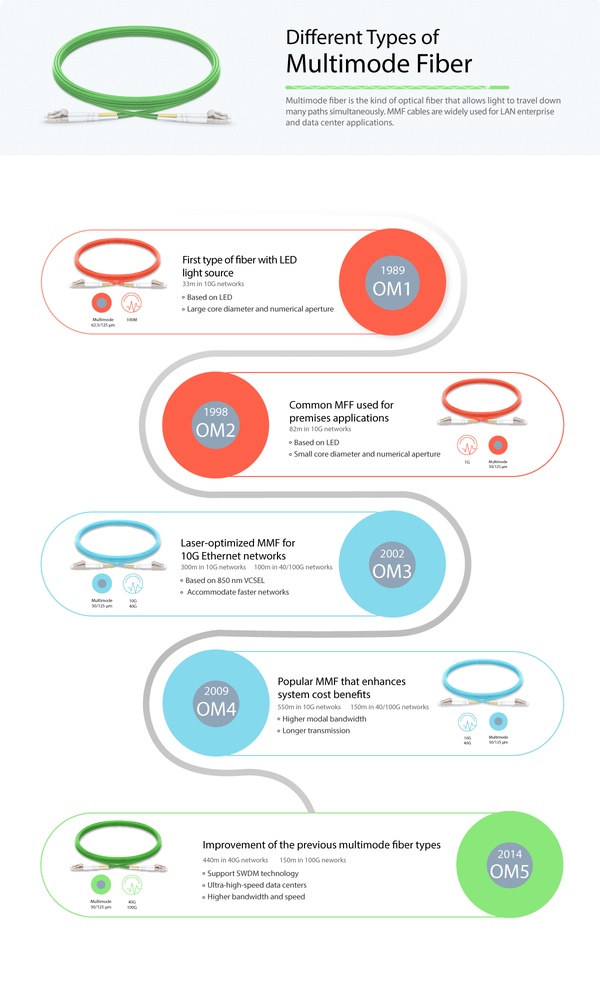
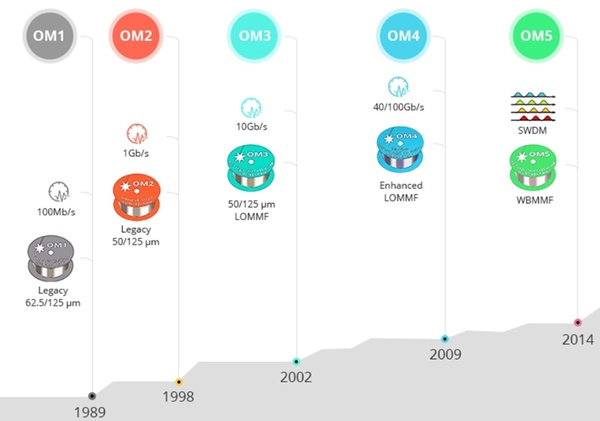
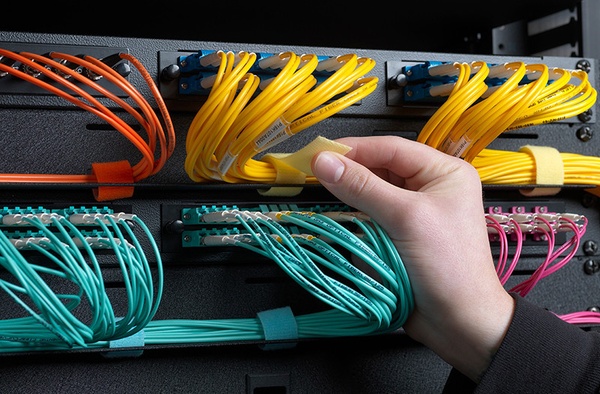
According to ISO 11801, multimode fiber optic cables are divided into OM1, OM2, OM3, OM4, and OM5. Each varies in core size, jacket color, optical source, data rate, and supported distance.
OM1 Fiber
-
Core: 62.5µm
-
Jacket: Orange
-
Light Source: LED
-
Supports 10GbE up to 33m
-
Common for 100Mb Ethernet
OM2 Fiber
-
Core: 50µm
-
Jacket: Orange
-
Light Source: LED
-
Supports 10GbE up to 82m
-
Typically used for 1Gb Ethernet
OM3 Fiber
-
Core: 50µm
-
Jacket: Aqua
-
Optimized for laser (VCSEL)
-
10GbE up to 300m; supports 40/100GbE up to 100m
OM4 Fiber
-
Core: 50µm
-
Jacket: Aqua
-
Optimized for laser (VCSEL)
-
10GbE up to 550m; supports 40/100GbE up to 150m
OM5 Fiber
-
Core: 50µm
-
Jacket: Lime Green
-
Known as WBMMF (wideband multimode fiber)
-
Supports multiple WDM channels at 28Gbps each across 850–953nm
-
Backward compatible with OM4
OM1 vs OM2 vs OM3 vs OM4 vs OM5: Key Differences
The differences among these multimode fibers come from physical characteristics such as core size, bandwidth, jacket color, and light source. These physical properties directly influence data rate capacity and distance range.
-
OM1: 200MHz·km, supports up to 100Mb and limited 10Gb
-
OM2: 500MHz·km, supports 1Gb and short 10Gb
-
OM3: 2000MHz·km, ideal for 10Gb/40Gb/100Gb
-
OM4: 4700MHz·km, extended reach for high-speed Ethernet
-
OM5: 28000MHz·km, designed for WDM and next-gen networks
Multimode Fiber vs Single Mode Fiber
-
Core Diameter: Single mode fiber has a much smaller core (8–10µm), while multimode fiber ranges from 50–62.5µm.
-
Light Source: Multimode uses LEDs or VCSEL lasers, while single mode uses laser diodes.
-
Distance: Multimode supports up to 550m at 10GbE, while single mode reaches much longer distances.
-
Cost: Multimode fiber cable is more cost-effective than single mode.
-
Bandwidth: Single mode provides far higher bandwidth but at a higher price.
Multimode Fiber Connector Types
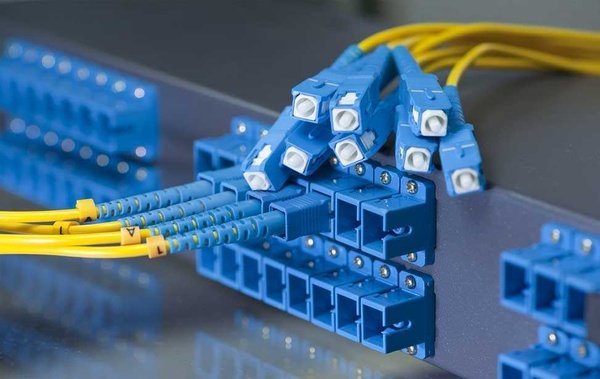
Common fiber connectors include SC, LC, FC, and ST, each with unique applications:
-
SC: Reliable and quick deployment
-
LC: High density, cost-effective
-
FC: Stable in vibration environments
-
ST: Rugged for military/industrial use
Advantages of Multimode Fiber
-
Cost-Effective: Cheaper than single mode for enterprise deployments
-
Supports Multiple Protocols: Works with Ethernet, Infiniband, and Internet protocols
-
Multi-User Capability: Handles multiple signals without interference
Conclusion
For most LANs, enterprise networks, and data centers, multimode fiber optic cables remain the most affordable and practical solution for distances up to 500–600m. While single mode fiber is best for long-haul networks, multimode fiber types (OM1–OM5) provide a balance of performance, cost, and flexibility for short-to-medium range high-speed networking.
We are a manufacturer of optical fiber and optical cables, including indoor and outdoor cables, non-metallic cables, flame-retardant cables, bundled tube cables, ribbon cables, data center cables, underwater cables, submarine cables, optoelectronic composite cables, base station field cables, drone cables, and detection and sensing cables. We offer affordable optical cables. We also manufacture supporting optical fiber equipment, including multi-mode optical fibers (OM1, OM2, OM3, OM4, and OM5), fiber optic connectors, patch cords, adapters, splitters, and Category 5, 6, and 7 network cables. For pricing on multimode OM1 fiber, please contact us. Multimode fiber manufacturers
Some pictures are from the Internet. If there is any inappropriateness, please contact us.