
Maximizing Fiber Optic Cable Range: Ultimate Installation Guide
Are you planning a fiber optic installation and want to understand the maximum transmission distances? Knowing how far fiber optic cable can carry data is essential for making informed decisions about your network infrastructure, ensuring your business remains efficient and scalable for decades. With the rapid growth of data demands, the choices you make today regarding fiber optic networks will significantly impact overall network performance and future scalability.
In this detailed guide, we will cover fiber optic transmission distances, the key factors influencing maximum range, and strategies to optimize your fiber optic installation for peak results.
Why Fiber Optic Cable Range is Critical
Before exploring specific distances, it’s important to understand why fiber optic cabling has become the standard for modern business connectivity:
| Advantage | Business Benefit |
|---|---|
| Higher Bandwidth | Support multiple users and applications concurrently |
| Longer Distance | Connect buildings or campuses without signal loss |
| Enhanced Security | Resistant to electromagnetic interference and eavesdropping |
| Future-Proof Scalability | Upgrade network equipment without recabling |
| Superior Reliability | Reduce downtime and maintenance costs |
How Fiber Optic Cable Range Works
Fiber optic cable transmission distance is influenced by two main physical factors affecting signal quality: attenuation and dispersion.
-
Attenuation: The reduction in signal strength as light passes through the fiber. Measured in decibels per kilometer (dB/km), lower values indicate better performance. Using high-quality fiber with low attenuation is essential to maximize transmission distances.
-
Dispersion: Occurs when light waves travel at varying speeds, causing the signal to spread and potentially degrade over time. Selecting fiber with optimized dispersion characteristics ensures reliable high-speed data transmission over long distances.
Single Mode vs. Multi Mode Fiber: Maximum Distance
The maximum range differs significantly between single-mode and multi-mode fiber.
-
Single Mode Fiber: Designed for long-distance data transmission, capable of carrying light signals over 100+ km without amplification. With repeaters, distances extend to thousands of kilometers, such as submarine cables across oceans. Common types:
-
OS1 fiber: Up to 10 km (indoor)
-
OS2 fiber: 200+ km (outdoor)
-
-
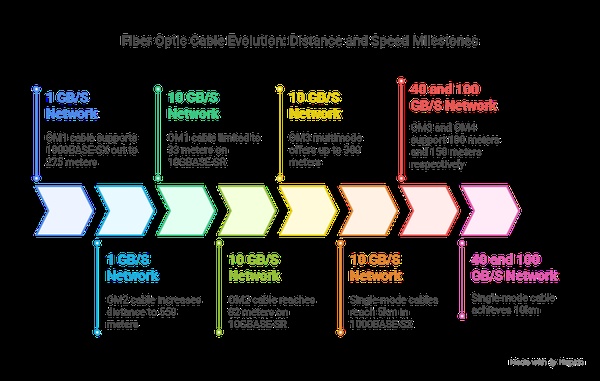
Multi Mode Fiber: Generally limited to 2 km, suitable for LAN backbones and short-range applications. Distance depends on fiber grade and network speed:
-
OM1 (62.5μm): 1G – 275m, 10G – 33m
-
OM2 (50μm): 1G – 550m, 10G – 82m
-
OM3 (50μm laser-optimized): 1G – 800m, 10G – 300m, 40/100G – 100m
-
OM4 (enhanced 50μm): 1G – 1 km, 10G – 550m, 40/100G – 150m
-
OM5 (wideband 50μm): Similar to OM4, optimized for wavelength division multiplexing
-
Fiber Optic vs. Copper Cables
Compared to traditional copper cables, fiber optic cabling supports much longer distances and higher reliability. Copper cables typically max out at 100 meters (328 feet), while fiber optic networks maintain signal integrity over several kilometers without degradation from EMI or attenuation.
Benefits of Fiber Optic Cable for Long-Distance
Fiber optic cables excel in long-distance applications:
-
Immunity to electromagnetic interference (EMI)
-
Zero electrical conductivity, enhancing safety
-
Minimal signal loss over extended distances
-
Stable performance under varying environmental conditions
-
Large bandwidth capacity, supporting future upgrades
Long-haul fiber optic networks routinely operate over hundreds of kilometers, with submarine cables spanning entire oceans using optical amplifiers.
Planning Your Fiber Optic Network
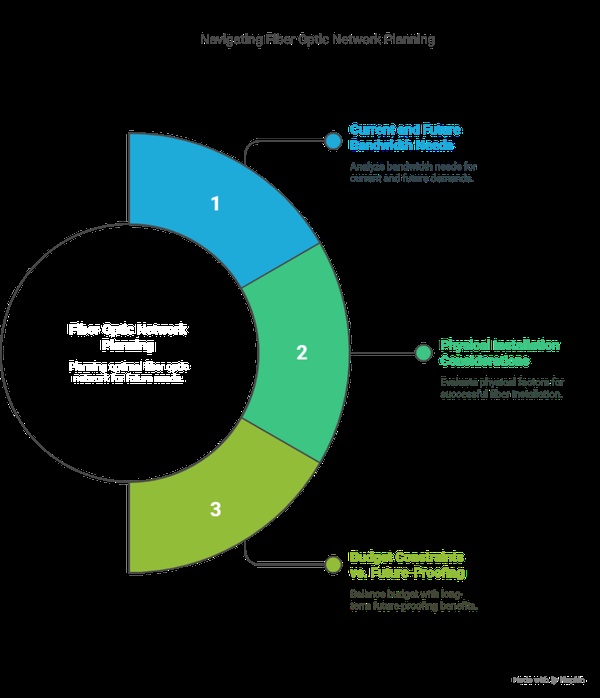
To design an optimal fiber optic installation, consider:
-
Current and Future Bandwidth Needs – Analyze peak usage, projected growth, and emerging technologies.
-
Physical Installation Factors – Evaluate building layouts, distance between rooms, cable pathways, and environmental conditions.
-
Cost vs. Future-Proofing – Properly specified fiber optic cable reduces long-term costs, avoids frequent recabling, and ensures scalable performance.
Maximizing Fiber Optic Cable Performance
Ensure peak performance by:
-
Using certified fiber optic installers
-
Regular inspections and maintenance
-
Choosing high-quality fiber optic components
-
Proper cable management and environmental protection
-
Monitoring and testing for potential issues
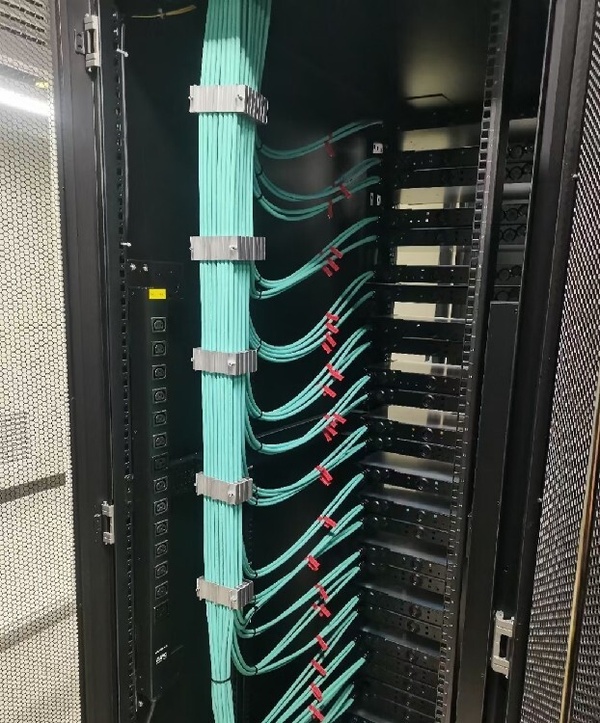
With proven installation methodologies and over 20,000 successful projects, your fiber optic network can achieve maximum reliability and performance.
Future Technologies
Advances in fiber optic technology include:
-
Multi-core fiber for ultra-high capacity
-
Advanced amplification systems
-
Wavelength division multiplexing for increased bandwidth
-
Specialized fibers for unique environments
These innovations ensure your fiber optic infrastructure remains capable of supporting emerging technologies and growing bandwidth needs for decades.
FAQs
How can I extend fiber optic distance?
-
Optical amplifiers or repeaters
-
Dispersion compensation
-
High-quality single-mode fibers (OS2)
-
Optimized wavelengths (e.g., 1550nm)
-
Professional installation and testing
Does weather affect fiber optic cable?
-
Properly installed fiber optic cabling is largely unaffected by rain, temperature, lightning, wind, or EMI.
-
Physical damage from extreme conditions can impact performance, highlighting the importance of protection and proper installation.
Contact Fiber Optic Experts
Our team specializes in fiber optic installations and provides guidance for all projects, including complimentary quotes. With nearly 20 years of experience and over 20,000 installations, we deliver reliable, future-proof fiber optic solutions.
We are a professional fiber optic manufacturer, producing a wide range of fiber optic cables, including indoor fiber optic cables, outdoor fiber optic cables, non-metallic cables, flame-retardant cables, loose tube cables, ribbon cables, data center cables, underwater cables, submarine cables, hybrid power and fiber optic cables, base station field cables, UAV cables, and sensing cables. Our fiber optic products come at competitive fiber optic prices, making them ideal for various networking projects.
In addition to fiber optic cables, we also manufacture supporting equipment such as optical splitters, multimode fiber, fiber connectors, fiber patch cords, fiber adapters, Cat5e cables, Cat6 cables, Cat7 cables, and more.
As a reliable fiber optic supplier, we provide wholesale fiber optic cables. If you want to inquire about fiber optic prices or bulk orders, feel free to contact us.
Some of our content is obtained from the Internet. If there is any inappropriateness, please contact us.