
CWDM DWDM MWDM and LWDM: Key Differences Explained
In the fast-evolving field of optical fiber communication, Wavelength Division Multiplexing (WDM) technology has become indispensable. It allows multiple optical signals, each with distinct wavelengths, to travel simultaneously within a single fiber, thereby improving transmission efficiency and network capacity. This article compares four major WDM variants—CWDM, DWDM, MWDM, and LWDM—to highlight their principles, differences, and applications.
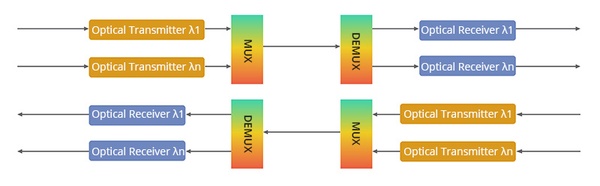
The Architecture of WDM Systems
Transmission Methods
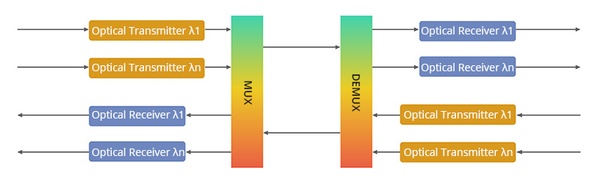
A WDM system generally adopts two types of configurations:
Dual-Fiber Unidirectional Transmission
In this mode, signals with different wavelengths are multiplexed at the transmitter and sent in a single direction through one fiber. At the receiving end, a demultiplexer separates them back into individual channels. For opposite-direction transmission, another fiber is deployed. This method ensures clear signal distinction across channels.
Single-Fiber Bidirectional Transmission
This design enables two-way communication within the same fiber, where each end transmits on different wavelengths to prevent overlap. This method effectively supports full-duplex communication while saving fiber resources.
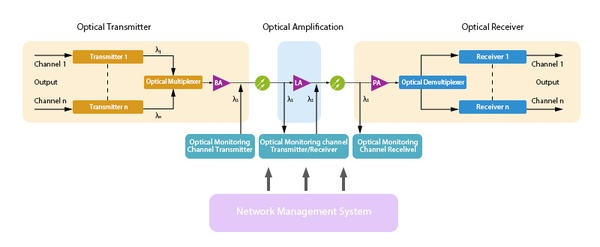
Core Components of WDM
Every WDM system typically consists of four essential modules:
-
Optical transmitter – generates optical signals.
-
Optical relay amplifier – boosts weakened signals over long distances.
-
Optical receiver – converts optical signals back to electrical signals.
-
Optical supervisory channel – ensures system monitoring and control.
Additionally, multiplexers and demultiplexers play a crucial role. The multiplexer combines several wavelength signals into one fiber, while the demultiplexer separates them at the destination. Their efficiency directly determines the transmission quality of the entire system.
CWDM vs. DWDM
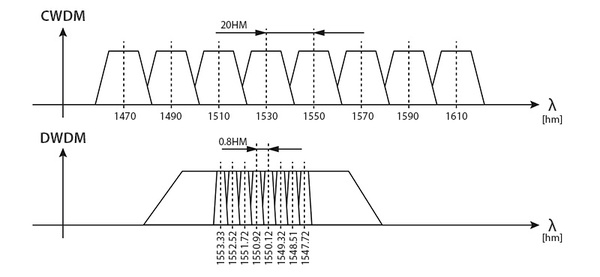
CWDM (Coarse Wavelength Division Multiplexing) is widely applied in metropolitan networks. It supports 18 channels, spaced 20 nm apart, within the 1270–1610 nm range, covering multiple fiber bands. Its relatively simple design reduces equipment cost and power consumption, making it an economical choice for operators.
DWDM (Dense Wavelength Division Multiplexing), in contrast, compresses wavelength spacing to 0.4–1.6 nm (50–200 GHz), supporting up to 160 channels in one fiber. This allows extremely high data throughput and long-distance transmission. Although more complex and power-hungry than CWDM, DWDM is unmatched for backbone and intercity networks.
Key differences include:
-
CWDM uses broader channel spacing, eliminating the need for optical line amplifiers.
-
DWDM offers higher capacity and longer reach but at higher deployment costs.
MWDM vs. LWDM
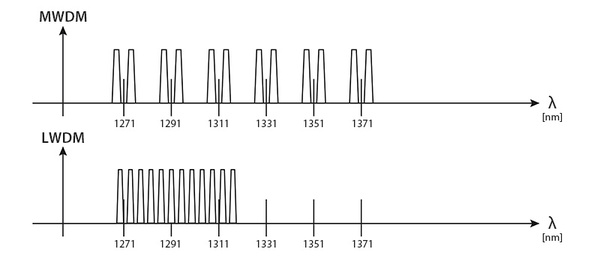
MWDM (Metro WDM) is an extension of CWDM, focusing on metro-area deployments. By narrowing channel spacing from 20 nm to 7 nm and using TEC temperature control, MWDM doubles certain CWDM channels to create up to 12 wavelengths. It maintains cost-effectiveness while meeting medium-distance transmission requirements, usually around 10 km.
LWDM (LAN WDM) is designed for short-distance networks such as data centers and enterprise LANs. Operating in the O-band (1260–1360 nm), it uses 12 channels with 4 nm spacing, ensuring low dispersion and stability. LWDM is commonly integrated into 100G optical modules and is ideal for distances within 10 km.
Main distinctions:
-
MWDM fits medium-range communication in metro environments.
-
LWDM is optimized for LAN or campus networks, with lower costs for short-haul deployments.
Application Scenarios
-
CWDM – Used in cable TV networks and metro access layers, offering cost-efficient multi-service delivery.
-
DWDM – Best for long-haul backbone transmission, supporting high-capacity enterprise and carrier networks.
-
MWDM – Balances cost and capacity, ideal for regional networks connecting multiple cities or facilities.
-
LWDM – Applied in enterprise intranets, offices, and campus networks for efficient internal communication.
Conclusion
Together, CWDM, DWDM, MWDM, and LWDM illustrate the versatility of WDM technology in modern optical communication. From cost-effective access solutions to high-capacity backbone systems, each variant fulfills specific roles in different distances and network environments. Understanding their distinctions helps operators and enterprises select the right solution for efficient and reliable optical fiber transmission.
We are a fiber optic manufacturer that produces optical fiber and optical cables, including indoor optical cables, outdoor optical cables, non-metallic optical cables, flame-retardant optical cables, bundled tube optical cables, ribbon optical cables, data center optical cables, underwater optical cables, submarine optical cables, optoelectronic composite optical cables, base station field optical cables, drone optical cables, and detection and sensing optical cables. The optical cables we produce are affordable. We also produce optical fiber supporting equipment, such as fiber optic splitters, multimode optical fibers, fiber optic connectors, fiber optic patch cords, fiber optic adapters, fiber splitters, Category 5, Category 6, and Category 7 network cables. For inquiries about armored optical cable prices, please contact us. Armored Optical Cable Manufacturer
Some pictures are from the Internet. If you have any questions, please contact us.
Wow, fantastic blog format! How long have you been running a blog for?
you make running a blog look easy. The whole look of your website is
excellent, let alone the content material!
Thank you for your message. We have specialized in fiber optic cables for over 20 years; please feel free to contact me anytime if you have any procurement needs in this area.