
Fiber Optic Cable Types Guide – Single Mode vs Multimode
Why Do We Have Different Fiber Optic Cable Types?
There are multiple fiber optic cable types because each design is tailored for specific applications with unique requirements for bandwidth, signal transmission distance, and installation environment. Choosing the right fiber cable depends on the project’s performance goals, network architecture, and budget.
Unlike traditional copper cables that rely on electrical signals, fiber optic cables transmit data as pulses of light traveling through strands of glass or plastic. The fiber’s core—made of highly transparent material—allows light to pass with minimal attenuation. This makes fiber systems ideal for high-speed and long-distance connectivity with reduced interference.
While copper cables are still used, fiber cables outperform them in speed, distance, durability, and resistance to electromagnetic interference, making them the preferred choice for modern networks.
Main Fiber Optic Cable Categories
-
Single mode fiber
-
Multimode fiber
-
Plastic optical fiber (POF)
-
Armored fiber cable
-
Bend-insensitive fiber
Below we explore the most widely used: single mode fiber, multimode fiber, and armored fiber cable.
Single Mode Fiber Cable
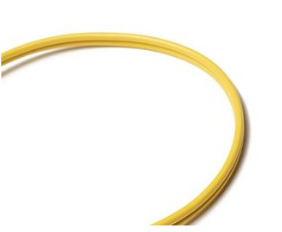
Single mode fiber optic cable has a very small core diameter (about 9 microns), which allows just one mode of light to pass through. This ensures low signal dispersion, longer transmission distances, and higher bandwidth capacity. It is widely used in telecom networks, cable TV systems, and long-haul data connections.
OS1 Single Mode Fiber Cable
OS1 fiber supports up to 10 km transmission without repeaters. With attenuation of 0.4 dB/km at 1310 nm, OS1 is suitable for indoor fiber installations and legacy networks.
OS2 Single Mode Fiber Cable
OS2 fiber offers better performance, transmitting up to 40 km at 10 Gbps with attenuation as low as 0.3 dB/km. OS2 is ideal for outdoor fiber networks and long-distance high-capacity links.
Multimode Fiber Cable
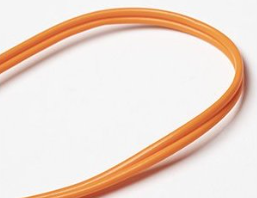
Multimode fiber cable has a larger core size (50 or 62.5 microns), enabling multiple light paths. This makes it cost-effective but limits distance compared to single mode. It is best suited for LAN networks, data centers, and short-distance connections.
OM1 Multimode Fiber
-
Core: 62.5 µm
-
Distance: 300 m at 10 Gbps
-
Bandwidth: 200 MHz·km
OM2 Multimode Fiber
-
Core: 50 µm
-
Distance: 550 m at 10 Gbps
-
Bandwidth: 500 MHz·km
OM3 Multimode Fiber
-
Optimized for laser transmission
-
1000 m at 10 Gbps, 400 m at 40 Gbps
-
Bandwidth: 2000 MHz·km
OM4 Multimode Fiber
-
Designed for 40G and 100G Ethernet
-
550 m at 40 Gbps, 150 m at 100 Gbps
-
Bandwidth: 4700 MHz·km
OM5 Multimode Fiber
-
Core: 50 µm
-
Optimized for wavelength division multiplexing (SWDM)
-
1000 m at 40 Gbps, 150 m at 100 Gbps
-
Bandwidth: 4700 MHz·km
Fiber Core Sizes and Wavelengths
-
Single mode fiber core: 9 µm, optimized for 1310 nm and 1550 nm.
-
Multimode fiber core: 50–62.5 µm, operating between 850 nm and 1300 nm.
Single mode fibers offer higher bandwidth and longer distances, while multimode fibers provide a cost-effective solution for shorter links.
Indoor Fiber Cable
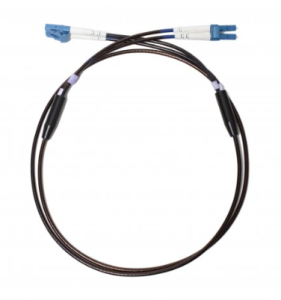
Indoor fiber cable is used in offices, data centers, and commercial buildings. It features protective layers, strength members, and jackets for durability. Available in both single mode and multimode, with connectors like SC, LC, ST.
Outdoor Fiber Cable
Outdoor fiber optic cable is built with rugged jackets to withstand harsh conditions such as temperature changes, UV radiation, and moisture. It is commonly deployed for telecommunication backbones and long-haul links.
Armored Fiber Cable
Armored fiber optic cable includes an additional protective layer (steel or reinforced plastic) to prevent crushing, cutting, or rodent damage. It is recommended for underground installations, industrial environments, and security-sensitive networks.
Bend-Insensitive Fiber Cable
Also known as bend-resistant fiber, this design minimizes signal loss when bent around corners or routed through tight spaces. Products like AnyAngle OM4 LC LC patch cable are popular in data centers and high-density networks where flexible routing is crucial.

Conclusion
When choosing between single mode vs multimode fiber, consider your network requirements:
-
For long-distance, high-bandwidth applications → choose single mode fiber.
-
For short-distance, cost-efficient LAN networks → choose multimode fiber.
-
For harsh environments → use armored fiber cable.
-
For space-limited installations → select bend-insensitive fiber.
Partnering with an expert fiber optic cable manufacturer ensures you select the right cable type for optimal network performance.
We are a professional fiber optic manufacturer, producing a wide range of fiber optic cables including indoor cables, outdoor cables, non-metallic cables, flame-retardant cables, loose tube cables, ribbon cables, data center cables, submarine cables, underwater cables, optical-electrical composite cables, base station field cables, drone cables, and sensing detection cables. Our multimode fiber optic cables are available at competitive prices.
In addition, we manufacture supporting fiber optic products such as fiber optic splitters, multimode fiber, fiber optic connectors, fiber patch cords, fiber adapters, Cat5, Cat6, and Cat7 network cables. As a multimode fiber optic cable manufacturer, we supply wholesale multimode fiber optic cables, and for inquiries about multimode fiber optic cable prices, please contact us. We are a reliable multimode fiber optic cable supplier for both domestic and international markets.
Some of our content comes from the Internet. If there is any inappropriateness, please contact us.