
Cat 6 vs Cat 6A: Key Differences for Modern Network Performance
Introduction to Cat 6 and Cat 6A Cabling
When it comes to structured cabling, Category 6A (or Cat 6A) provides enhanced performance compared to Cat 6, which is why the “A” stands for augmented. Understanding the technical differences between Cat 6 and Cat 6A can help you determine which cabling solution fits your network requirements, budget, and long-term goals.

Overview of Cat 6 Cabling
Cat 6 cabling was officially ratified by TIA standards in 2002, shortly after Cat 5e. While Cat 5e operated at 100 MHz and supported Gigabit Ethernet over 100 meters, Cat 6 increased the frequency to 250 MHz. Despite supporting the same Gigabit speeds initially, Cat 6 offered significant advantages in bandwidth and performance.
In environments with heavy crosstalk or high data demands, Cat 5e often struggled with higher bit error rates. Cat 6 solved these issues with a plastic spline separating twisted pairs and slightly thicker 23 AWG wires, which also improved heat handling for PoE (Power over Ethernet) applications. With IEEE 802.3af Type 1 delivering up to 15W and IEEE 802.3at Type 2 delivering up to 30W, Cat 6 became the preferred choice for growing network demands. Over time, the cost difference decreased, and today Cat 6 cabling is only about 10–15% more expensive than Cat 5e.
Advantages of Cat 6A Cabling
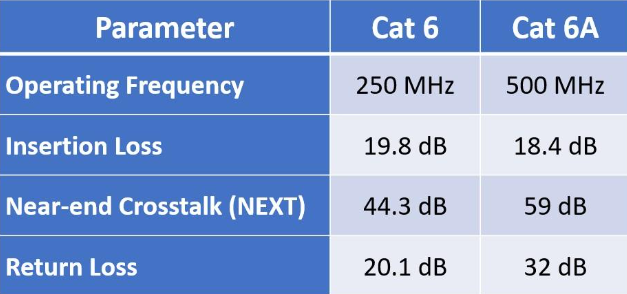
Introduced in 2009, Cat 6A significantly boosts the performance of twisted-pair cabling. Operating at 500 MHz, it supports 10 Gigabit Ethernet over 100 meters. Achieving this required tighter manufacturing tolerances, precise twist rates, and improved insulation. Compared to Cat 6, Cat 6A delivers 7% better insertion loss, 25% better near-end crosstalk, and 37% improved return loss.
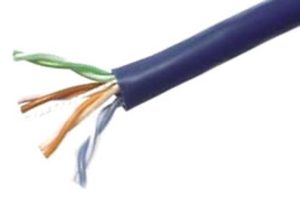
Although Cat 6A shares the 23 AWG conductor size with Cat 6, enhanced pair twist, larger spline, and thicker jacket increase cable diameter. Early versions reached 0.35″ versus 0.24″ for Cat 6, requiring more installation space. Modern manufacturing has reduced these sizes without affecting performance. The cost premium is now roughly 20% over Cat 6, making it a future-proof option.
Choosing Between Cat 6 and Cat 6A
Selecting between Cat 6 and Cat 6A depends on network speed requirements and application demands. Some Cat 6 installations may handle 10 Gigabit Ethernet for 35–55 meters, but qualification testing is essential. Cat 6 and even high-quality Cat 5e can support 2.5–5 Gig speeds for Wi-Fi 5, though testing remains critical.
In contrast, Cat 6A reliably supports all speeds up to 10 Gigabit over 100 meters. Its superior insertion loss performance enables robust support for 802.3bt Type 3 PoE (up to 60W) and Type 4 PoE (up to 90W). Heat and distance can affect insertion loss, so using Cat 6 for high-power PoE may limit maximum link lengths.
Industry standards recommend Cat 6A for new deployments due to its enhanced future-proofing. For tight budgets, Cat 6 is viable for Gigabit speeds and lower PoE levels. However, the small additional cost of Cat 6A outweighs the risk of insufficient network performance and potential replacement expenses.
JXL: Your Trusted Cabling Partner
The good news is that JXL offers a comprehensive selection of copper cabling solutions. If you are uncertain whether Cat 6 or Cat 6A is best for your network, JXL experts are ready to provide guidance and help you choose the optimal cabling solution for your needs.
We are a professional fiber optic manufacturer, specializing in the production of various fiber optic cables, including indoor fiber optic cables, outdoor fiber optic cables, non-metallic fiber optic cables, flame-retardant fiber optic cables, loose tube fiber optic cables, ribbon fiber optic cables, data center fiber optic cables, submarine fiber optic cables, underwater fiber optic cables, optical-electrical composite fiber optic cables, base station field fiber optic cables, drone fiber optic cables, and sensing fiber optic cables. Our outdoor fiber optic cables are offered at competitive prices.
In addition, we manufacture supporting fiber optic products such as fiber optic splitters, multimode fiber, fiber optic connectors, fiber optic patch cords, fiber optic adapters, Cat5, Cat6, and Cat7 network cables. As an outdoor fiber optic cable manufacturer, we provide wholesale outdoor fiber optic cables, and for inquiries about outdoor fiber optic cable prices, please contact us. We are a trusted outdoor fiber optic cable supplier serving both domestic and international markets.
Some of our content comes from the Internet. If there is any inappropriateness, please contact us.