
ONT vs ONU 3 Major Differences You Need to Know in Fiber Optic Networks
The Optical Network Terminal (ONT) and the Optical Network Unit (ONU) are essential components in modern fiber optic access networks. Both devices serve as the bridge connecting end-users with the service provider’s network, ensuring fast and reliable fiber optic internet. Although the two terms are often used interchangeably, there are several key distinctions that separate ONT from ONU.
Definition Differences
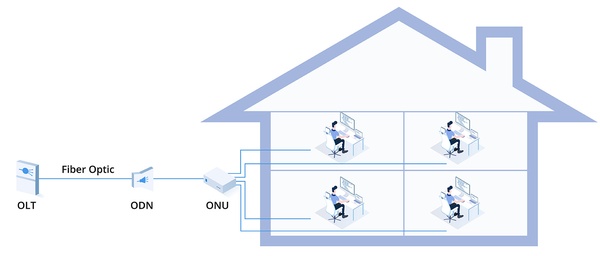
The ONU is typically deployed on the user side of a fiber optic network, but it may still connect through intermediate distribution networks before reaching the end-user. Its core role is to convert optical signals from the Optical Distribution Network (ODN) into electrical signals, which are then processed to deliver services such as broadband internet, VoIP telephony, and IPTV streaming.
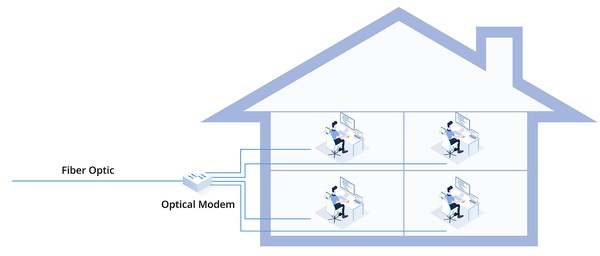
The ONT, in contrast, is positioned directly at the end-user’s premises. It links home or office devices through an optical network interface. In Fiber-to-the-Home (FTTH) deployments, the ONT is commonly known as an optical modem, converting optical signals into usable outputs. It provides multiple interfaces to connect devices like PCs, telephones, and smart TVs.
Application Scenarios and Placement
In FTTH networks, the distinction between ONT and ONU is often blurred. Because the fiber reaches directly into the home, the ONT integrates the typical functions of the ONU, creating a single device that manages both optical-to-electrical conversion and user connectivity.
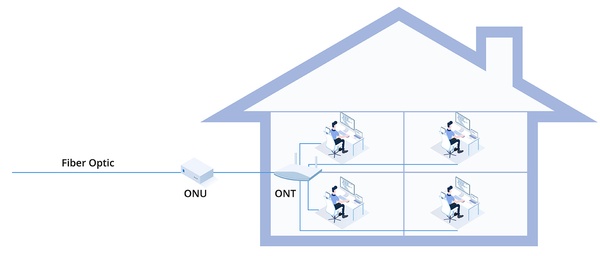
In Fiber-to-the-Building (FTTB) or larger multi-user environments, the roles are more clearly divided. The ONU may be installed in a building’s equipment room or shared network cabinet, aggregating signals from multiple users. The ONT, however, is placed within each subscriber’s unit, acting as the final access point for personal network usage.
Functional Hierarchies
The ONU mainly operates at the network level, performing tasks such as signal conversion, traffic aggregation, and service processing between access and aggregation layers. The ONT, on the other hand, works at the end-user level, ensuring direct connectivity for consumer applications and devices.
Conclusion
While ONT and ONU are closely related in fiber optic access networks, they differ in their placement and functionality. In FTTH solutions, the ONT often takes on the role of both ONT and ONU, acting as the all-in-one optical modem. In more complex network infrastructures like FTTB, the ONU is positioned closer to the provider’s network, while the ONT stays closest to the end-user.
Understanding the distinctions between ONT vs ONU helps businesses, service providers, and end-users choose the right equipment for reliable fiber optic internet performance.
We are a fiber optic manufacturer specializing in the production of optical fiber and optical cables, including indoor and outdoor cables, non-metallic cables, flame-retardant cables, bundled tube cables, ribbon cables, data center cables, underwater cables, submarine cables, optoelectronic composite cables, base station field cables, drone cables, and detection and sensing cables. We offer affordable optical cables and also manufacture ancillary optical equipment, such as optical fiber terminals (ONTs), multimode optical fibers, fiber optic connectors, fiber optic patch cords, fiber optic adapters, fiber optic splitters, and Category 5, 6, and 7 network cables. For ONT terminal pricing, please contact us.
Some pictures are from the Internet. If there is any inappropriateness, please contact us.