
Fiber Optic Splitter Guide: Definition, Types, Manufacturing, Testing, and Applications
Introduction
A fiber optic splitter is a passive optical component that divides a single input light signal into multiple outputs, enabling efficient distribution of optical power across a network. With the growing demand for FTTH (Fiber to the Home) and PON (Passive Optical Network) systems, splitters have become indispensable for maximizing fiber utilization and simplifying network architecture.
This article provides a comprehensive overview of fiber optic splitters, covering their definition, major types such as PLC splitters and FBT splitters, detailed manufacturing processes, testing standards, and real-world applications.

What Is a Fiber Optic Splitter?
A fiber optic splitter, sometimes referred to as an optical splitter, is designed to take a single incoming optical signal and divide it into two or more outputs. Unlike active devices, splitters do not require external power, which makes them reliable, low-maintenance, and cost-efficient.
Functionally, a splitter acts like a water pipeline that branches into multiple channels. One light signal enters the splitter and is distributed evenly—or in some cases unevenly—among several output fibers. This eliminates the need for deploying a dedicated optical line to each user, thus saving both fiber resources and installation costs.
There are two primary categories of fiber splitters based on their manufacturing method:
-
PLC Splitters (Planar Lightwave Circuit)
-
FBT Splitters (Fused Biconical Taper)
Both have unique advantages, and their usage depends on the scale, performance requirements, and budget of the network deployment.
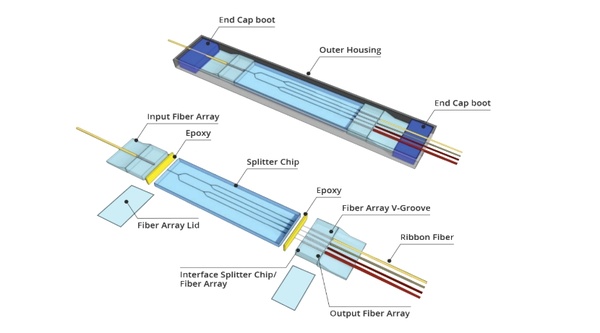
PLC Splitters
PLC splitters are built using silica glass waveguide technology and are known for their high precision and uniformity in distributing optical signals. They are ideal for large-scale applications such as FTTH networks where high split ratios and consistent performance are required.
Balanced vs. Unbalanced PLC Splitters
Standard PLC splitters distribute the optical signal evenly among output channels (balanced). However, in some cases, network operators may need unequal distribution (unbalanced) to allocate resources differently across endpoints. For example, an unbalanced 1×5 PLC splitter can assign 20%, 33%, 50%, 75%, or 95% of the optical power to one channel, while distributing the remainder across the other four outputs. This flexibility makes unbalanced PLC splitters increasingly popular in advanced network architectures.

Packaging Options
Suppliers offer PLC splitters in a variety of packaging formats to suit different deployment environments:
-
Bare PLC splitter – compact, unprotected design for integration into existing systems.
-
Blockless PLC splitter – small form factor for limited-space installations.
-
ABS PLC splitter – housed in durable ABS plastic, widely used in standard deployments.
-
LGX box PLC splitter – modular design for easy installation in LGX chassis.
-
FHD PLC splitter – optimized for high-density applications.
-
Rack-mount PLC splitter – fits into 1U racks, convenient for data centers and telecom rooms.
Each packaging style supports different use cases, from large-scale backbone networks to small enterprise solutions.

FBT Splitters
FBT splitters are manufactured by fusing and tapering two or more fibers together. This process allows operators to customize the split ratio, making FBT splitters more flexible in small-scale or cost-sensitive projects.
Key Features of FBT Splitters
-
Customizable ratios – enables different distribution levels depending on application requirements.
-
Lower cost – compared with PLC splitters, they are more budget-friendly.
-
Suitable for small networks – ideal for scenarios where high split ratios are not required.
PLC vs. FBT Splitters
While both PLC splitters and FBT splitters serve the same function of dividing optical signals, they differ significantly in performance:
-
PLC splitters provide stable performance across wide bandwidths and higher split counts (up to 1×64 or higher).
-
FBT splitters are more affordable but less consistent, with limited split ratios (usually ≤1×8).
In modern large-scale FTTH and PON deployments, PLC splitters are preferred due to their reliability and scalability, though FBT splitters still remain in use for smaller applications.
How Fiber Optic Splitters Are Manufactured
The production of a fiber optic splitter involves high precision and strict process control. Taking PLC splitters as an example, the process generally includes five main stages:
-
Component Preparation
-
Key components include the PLC chip, input fiber array, and output fiber array.
-
The PLC chip is fabricated on a silica glass wafer, polished for precision, and integrated with fiber arrays through v-groove substrates.
-
-
Alignment
-
The fiber arrays are carefully aligned with the PLC chip using specialized aligner stages.
-
Continuous optical power monitoring ensures accurate alignment and minimal signal loss.
-
-
Curing
-
Once aligned, the assembly is stabilized inside a UV curing chamber at controlled temperatures.
-
This step permanently bonds the fibers and chip together.
-
-
Packaging
-
The bare splitter assembly is encased in protective housings, such as metal or ABS enclosures.
-
Temperature cycling tests are performed to guarantee long-term stability.
-
-
Optical Testing
-
Each splitter undergoes rigorous testing for insertion loss, uniformity, and polarization dependent loss (PDL) to ensure compliance with GR-1209 CORE standards.
-
Testing the Quality of Fiber Optic Splitters
The performance of a fiber optic splitter is defined by several optical specifications. Common tests include:
-
Optical Bandpass Test – verifies that the splitter can operate within the required wavelength range using an optical spectrum analyzer.
-
Insertion Loss Test – measures the amount of signal loss when light passes through the splitter, performed with a power meter and light source.
-
Return Loss Test – determines how much signal is reflected back toward the source, measured with a return loss meter.
-
Uniformity Test – ensures that signal loss across all output channels is consistent and within tolerance levels.
-
Directivity Test – checks for unwanted signal leakage between ports, performed similarly to insertion loss testing.
These tests guarantee that splitters meet industry standards and provide reliable performance in real-world environments.
Applications of Fiber Optic Splitters in PON Systems
Fiber optic splitters are widely deployed in PON networks, particularly in FTTH architectures, to distribute optical signals from a central office to multiple user endpoints.
Centralized (Single-Stage) Architecture
-
A single 1×32 splitter is typically placed in the central office.
-
The splitter connects one OLT (Optical Line Terminal) port to 32 ONTs (Optical Network Terminals).
-
This setup is simple and cost-efficient for densely populated areas.
Cascaded (Multi-Stage) Architecture
-
Multiple splitters are deployed in a hierarchical design.
-
For example, a 1×4 splitter connects to four 1×8 splitters, reaching 32 users in total.
-
Cascaded designs allow more flexible deployment across wider geographical areas.
Both architectures are widely used depending on subscriber density, geographic distribution, and cost considerations.

Conclusion
In conclusion, fiber optic splitters are essential for modern optical communication, enabling efficient signal distribution without requiring external power. By leveraging technologies such as PLC splitters for high-capacity applications and FBT splitters for smaller-scale needs, operators can optimize network performance and resource allocation.
As FTTH and PON deployments continue to expand, the demand for high-quality optical splitters will only grow. Selecting the right splitter type ensures cost-effectiveness, scalability, and long-term reliability in any fiber optic infrastructure.
For tailored solutions, professional suppliers like JXL provide customizable fiber optic splitters designed to meet diverse network requirements.
We are an optical fiber manufacturer that produces optical fibers and optical cables, including indoor optical cables, outdoor optical cables, non-metallic optical cables, flame-retardant optical cables, bundled tube optical cables, ribbon optical cables, data center optical cables, underwater optical cables, submarine optical cables, optoelectronic composite optical cables, base station field optical cables, drone optical cables, and detection and sensing optical cables. The optical cables we produce are affordable. We also produce optical fiber supporting equipment, such as fiber optic splitters, multimode optical fibers, fiber optic connectors, fiber optic patch cords, fiber optic adapters, fiber optic splitters, Category 5, Category 6, and Category 7 network cables. We are an outdoor optical cable manufacturer. If you need information on the price of fiber optic splitters, please contact us. Fiber optic splitter supplier
Some of our content is obtained from the Internet. If there is any inappropriateness, please contact us.