
Comprehensive Guide to Fiber Optic Connector Types
What is a Fiber Optic Connector?
A fiber optic connector is a critical component in modern optical communication systems. Its main function is to align and connect two or more optical fibers, allowing efficient signal transmission between devices such as transmitters, receivers, or other fiber optic components. Unlike electrical connections, optical communication uses light pulses to transfer data, making these connectors essential for high-speed, high-bandwidth networks.
Before reading this article, if you’d like to know how much fiber optic cable costs, feel free to contact us. Now let’s begin the main content.
Fiber optic connectors are commonly found in patch cords, pigtails, and active network components. They can be used with single-mode (SM), multi-mode (MM), polarization maintaining (PM), photonic-crystal (PCF), hollow-core (HC), or micro-structured fibers depending on the application.
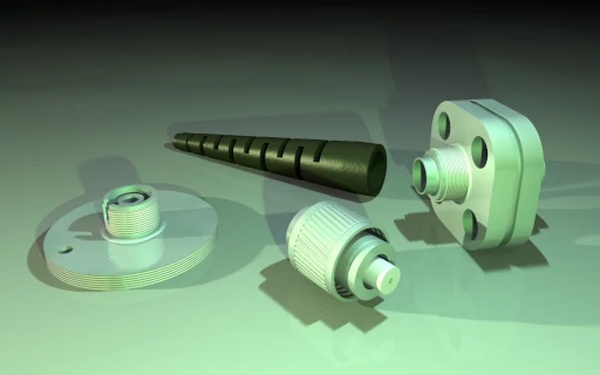
Main Components of a Fiber Optic Connector
Figure 1 below shows the main parts of a connector, including the fiber feedthrough flange, stress relief tubing, ferrule, and mating sleeve.
The ferrule—a cylindrical piece made from ceramic, stainless steel, or polymer—plays a key role in securing and aligning fibers during mating. The housing, or connector body, protects the ferrule and ensures a durable connection between fibers. Most housings are made from high-quality metal or reinforced plastic for better durability.
Other supporting components include the cable, adapter, and coupling sleeve. The ferrule extends slightly beyond the housing to fit securely into the mating sleeve or adapter, maintaining precise fiber alignment.
Figure 1: Fiber Optic Connector Components from left to right—fiber feedthrough flange, stress relief tubing, ferrule, and mating sleeve.
The type of connector used in a system depends on several factors, including fiber type, transmission speed, and connection distance.
Common Fiber Optic Connector Types
FC (Ferrule Core) Connector
The FC connector features a threaded stainless steel body with a ceramic ferrule. It provides strong mechanical stability, making it suitable for high-vibration environments. Unlike the SC and LC connectors, the FC uses a circular screw-type fitting, often nickel-plated for durability.
SC (Standard Connector)
The SC connector is square-shaped with a 2.5 mm ferrule and features a push-pull design for quick connection and disconnection. Its duplex configuration makes it ideal for telecommunication networks and data centers.
ST (Straight Tip)
The ST connector uses a bayonet mount and a 2.5 mm ceramic ferrule. It offers ruggedness and easy insertion, making it a popular choice for LAN, military, and enterprise fiber systems.
LC (Lucent Connector)
The LC connector is a small form-factor connector with a 1.25 mm ferrule, half the size of the SC. Its compact design supports high-density installations, such as data centers and telecommunication racks. LC fiber optic connectors are widely used in modern optical transceivers and active components.
SMA (SubMiniature A)
The SMA connector is designed for high-power laser applications, typically found in medical, biomedical, and industrial systems. With a stainless-steel body and threaded coupling, it provides excellent mechanical stability but has higher insertion loss (over 1 dB).

FC/PC (Fixed Connection – Physical Contact)
FC/PC connectors feature a 2.5 mm ferrule and a screw-type coupling mechanism. They offer excellent alignment precision and low return loss, making them suitable for telecommunications and testing equipment.
FC/APC (Angled Physical Contact)
The FC/APC connector is specifically designed to minimize back reflection by polishing the fiber end face at an angle. This makes it ideal for high-precision and high-vibration setups. However, they should only be connected to other FC/APC connectors to avoid increased insertion loss.
Table 1: Key Features and Applications of Fiber Optic Connectors
| Type | Coupling Type | Ferrule Diameter | Advantages | Disadvantages | Applications |
|---|---|---|---|---|---|
| LC/PC | Push-pull, small form factor | 1.25 mm | High-density, low loss | Fragile, higher cost | LAN, Data Centers |
| SC/PC | Push-pull, square shape | 2.5 mm | Easy handling | Not ideal for dense setups | SM fibers, Telecom |
| FC/PC | Screw-on, simplex/duplex | 2.5 mm | High precision, stable | Bulky, longer setup | Telecom, Testing |
| FC/APC | Threaded connection | 2.5 mm | Low reflection | Higher insertion loss | High-vibration systems |
| ST | Bayonet-style | 2.5 mm | Rugged, easy install | Lower density | LAN, Military |
| SMA | Screw coupling | ~3.4 mm | Very durable | Limited cycles | RF, Antenna, Testing |
| E2000 | Push-pull with dust cap | — | Reliable, low loss | Expensive | Telecom, Data Centers |
Simplex vs Duplex Fiber Connectors
Simplex fiber cables contain a single optical fiber, used for one-way transmission. These are ideal for systems that only send or receive data in one direction.
In contrast, duplex fiber connectors contain two fibers, arranged side by side, allowing bi-directional communication—sending and receiving signals simultaneously. Both are available in single-mode and multi-mode variants.
Multi-fiber connectors are also used in large-scale networks to combine multiple fibers into a single connection, improving space efficiency and network scalability.
Key Fiber Optic Connector Specifications
Cable Diameter
This refers to the maximum fiber cable diameter that can fit the connector housing. The diameter directly affects connector compatibility and mechanical stability.
Insertion Loss
Insertion loss measures the amount of optical power lost during light transmission through the connector. It’s expressed in decibels (dB) and typically ranges around 0.5 dB.
Insertion Loss=−10log(PoutPin)Insertion\ Loss = -10 \log \left( \frac{P_{out}}{P_{in}} \right)
Where PinP_{in} is the input power and PoutP_{out} is the output power.
Return Loss
Return loss, or reflectance, indicates how much light is reflected back toward the source. It’s also measured in dB, and higher values represent better connector performance.
Return Loss=−10log(P0P1)Return\ Loss = -10 \log \left( \frac{P_0}{P_1} \right)
Where P0P_0 is the reflected optical power and P1P_1 is the input power.
Termination Components and Accessories
Mating Sleeves / Adapters
Mating sleeves (or adapters) join two terminated fibers, ensuring low optical loss and secure physical contact. They come in multiple types—FC/PC, LC/APC, SC/PC, ST/PC, and SMA—to accommodate different connectors.
Fiber Port Collimators / Couplers
These specialized components are designed to couple light efficiently into or out of optical fibers. They feature high alignment precision and excellent thermal stability, ideal for both short- and long-term applications.
Connector Caps
Connector caps protect the end faces of connectors from dust, dirt, and contamination. They are used during installation, testing, and maintenance to ensure optimal signal performance.
Optical Fiber Mounts
Fiber mounts secure fiber components in precise alignment. They allow three-axis adjustment—vertical, horizontal, and focus—and are essential in laboratory or industrial setups that require fine optical positioning.
Figure 2: Schematic diagram of a fiber connector.
Conclusion
Choosing the right fiber optic connector depends on fiber type, application environment, insertion loss requirements, and density constraints. Connectors such as LC, SC, and FC/APC dominate today’s telecommunication and data center infrastructures, ensuring high performance, reliability, and scalability for future optical networks.
We are a professional fiber optic manufacturer specializing in producing a wide range of fiber optic cables, including indoor fiber optic cables, outdoor fiber optic cables, non-metallic cables, flame-retardant cables, loose tube cables, ribbon cables, armored cables, data center cables, underwater cables, submarine cables, composite fiber optic cables, base station and field cables, UAV fiber optic cables, and sensing cables.
Our fiber optic products are reliable and cost-effective. In addition to fiber optic cables, we also manufacture a variety of related components such as optical splitters, multimode fibers, fiber optic connectors, fiber patch cords, fiber adapters, and network cables (Cat5e, Cat6, Cat7).
We are a fiber optic connector manufacturer providing wholesale and customized solutions. If you are looking for fiber optic connector prices or need a trusted fiber optic connector supplier, please feel free to contact us for more information.
Some images and text in this article are sourced from the internet. If any issues arise, please contact us for resolution.