
Understanding Fiber Optic Connector Types and Their Applications
What is a Fiber Optic Connector?
Fiber optic connectors are crucial components in any optical network, enabling the connection and reliable transmission of light signals between devices. With numerous fiber connector types available, selecting the most suitable one for your application can be challenging. This guide compares the main fiber optic connectors, highlighting their unique features, benefits, and potential drawbacks to help you make an informed choice.
Applications of Fiber Optic Cable
Fiber optic cables transmit data using light, providing high-speed and high-capacity connections over long distances. Commonly used in telecommunications, internet service, and cable television, they also play a vital role in medical devices, industrial equipment, military communication systems, and transportation networks. Light-based transmission ensures low interference, faster data transfer, and longer reach compared to traditional copper cables.
Key Fiber Connector Types
Choosing the right fiber optic connector depends on the application, considering factors such as insertion loss, return loss, durability, ease of use, and cost. Each connector type offers unique advantages:
SC Fiber Connector (Subscriber Connector)
The SC connector, or “Subscriber Connector,” features a push-pull locking mechanism and a 2.5mm ferrule. Available in both single-mode and multi-mode, SC connectors are popular in telecommunications networks due to their easy installation and reliable performance.
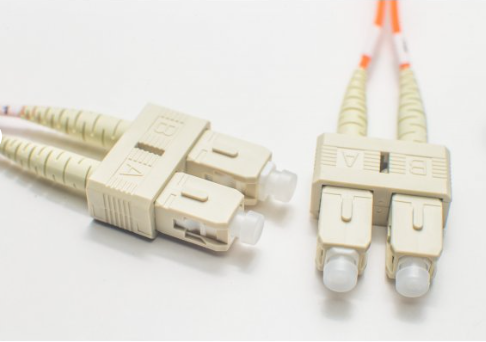
SC Fiber Connectors
Key Features:
-
Push-pull latching mechanism ensures a stable connection.
-
Low insertion loss (<0.5 dB) maintains signal integrity.
-
Durable design withstands frequent connections.
-
Compatible with a wide range of equipment.
JXL provides SC fiber optic cables in singlemode and multimode duplex across OM1, OM2, OM3, OM4, and OS2. Options include SC to SC, SC to ST, and SC to LC indoor/outdoor patch cables.
LC Fiber Connector (Lucent Connector)
The LC connector, or “Lucent Connector,” is compact, with a 1.25mm ferrule and clip-locking mechanism. It suits high-density environments like data centers where space is limited.
Key Features:
-
Small form-factor ideal for dense installations.
-
Clip-locking mechanism ensures secure connections.
-
Low insertion loss (<0.5 dB).
-
Compatible with enterprise and data center networks.
JXL offers LC fiber optic cables in singlemode and multimode duplex, supporting OM1, OM2, OM3, OM4, and OS2, with options for indoor, outdoor, OFNR, and OFNP rated cables.
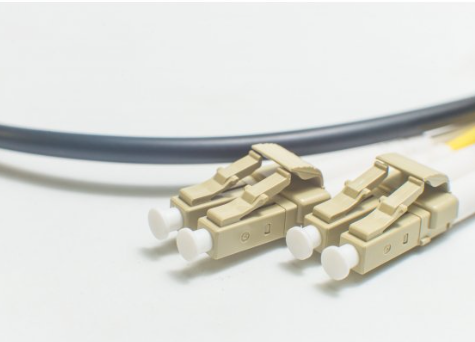
SC vs LC Connectors
Similarities: Both use ceramic ferrules and maintain low insertion loss (<0.5 dB), compatible with single-mode and multimode fiber.
Differences: LC connectors are smaller with a clip-locking mechanism; SC connectors are larger, use push-pull, and are widely compatible. Cable diameter varies: SC (2.5–3.0mm), LC (0.9–1.6mm). The choice depends on application requirements.
ST Fiber Connector (Straight Tip Connector)
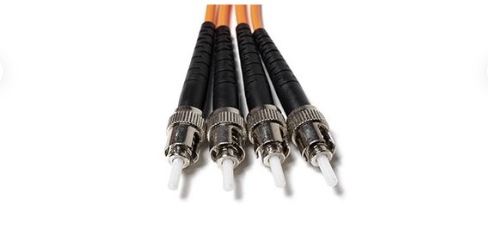
ST connectors feature a bayonet-style lock and a 2.5mm ferrule. Popular in industrial settings and legacy networks, they provide durable, reliable connections.
Key Features:
-
Bayonet mount ensures stability.
-
Cost-effective for legacy networks.
-
Durable and compatible with existing ST equipment.
JXL provides ST fiber optic cables in singlemode and multimode across OM1–OS2, including SC to SC, SC to ST, and SC to LC options.
FC Fiber Connector (Ferrule Core Connector)
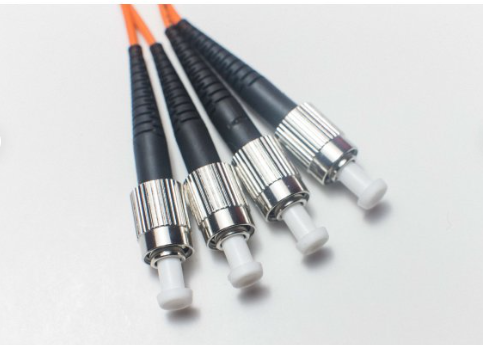
FC connectors are ideal for high-speed storage area networks (SANs), offering a threaded design for secure connections.
Key Features:
-
Threaded design stabilizes connections for high-speed transmission.
-
Supports data rates from 4 Gbps up to 64 Gbps.
-
Durable and cost-effective for high-performance environments.
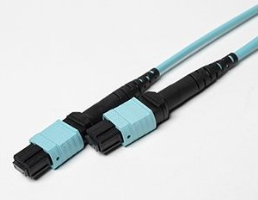
MPO Fiber Connector (Multi-Position Optical)
MPO connectors support high-density connections, commonly used in data centers and high-performance computing.
Key Features:
-
Supports up to 72 fibers in a compact form.
-
High-speed data transmission (40–400 Gbps).
-
Low insertion loss (<0.5 dB) and durable.
MT-RJ Fiber Connector (Mechanical Transfer Registered Jack)
MT-RJ connectors resemble RJ45 Ethernet plugs, designed for high-density, high-speed connections.
Key Features:
-
Compact size for dense applications.
-
High-speed support up to 10 Gbps.
-
Durable with low insertion loss (<0.5 dB).
Best Use Cases for Each Connector Type
LC Fiber Connector:
-
Data centers, enterprise networks, fiber-to-desk setups, medical and industrial equipment, high-speed internet.
SC Fiber Connector:
-
Telecommunication networks, ISPs, cable television, military communication, industrial environments.
ST Fiber Connector:
-
Legacy networks, industrial equipment, LANs, military communication.
FC Fiber Connector:
-
SANs, high-performance computing, data centers, industrial and military applications.
MPO Fiber Connector:
-
Data centers, high-bandwidth computing, telecom networks, parallel optics transceivers.
MT-RJ Fiber Connector:
-
Data centers, high-performance computing, telecom networks, parallel optics, high-speed internet.
We are a professional fiber optic manufacturer, specializing in the production of fiber optic cables such as indoor fiber optic cables, outdoor fiber optic cables, non-metallic fiber cables, flame-retardant fiber cables, loose tube fiber cables, ribbon fiber cables, data center fiber cables, submarine fiber cables, underwater fiber cables, optical-electrical composite fiber cables, base station field fiber cables, drone fiber cables, and sensing fiber optic cables. Our Fiber Optic Connectors are manufactured to ensure reliable, high-performance fiber optic connections.
In addition, we produce fiber optic accessories including Fiber Optic Connectors, fiber optic splitters, multimode fiber, fiber optic patch cords, fiber optic adapters, Cat5, Cat6, and Cat7 network cables. As a Fiber Optic Connector manufacturer, we offer wholesale Fiber Optic Connectors, and for inquiries about Fiber Optic Connector prices, please contact us. We are a trusted Fiber Optic Connector supplier, serving both domestic and international fiber optic projects.
Some of our content comes from the Internet. If there is any inappropriateness, please contact us.