
Data Center Server Rack Guide: Types, Selection Tips & Buying Advice
High-density data center environments demand organized, secure, and efficient equipment housing. The right server rack plays a central role in consolidating routers, switches, servers, PDUs, and other infrastructure — improving cooling, power distribution, and cable routing while protecting gear from physical hazards. This guide explains what a server rack is, compares common rack types, and gives a practical buying checklist so you can pick the right solution for your facility.
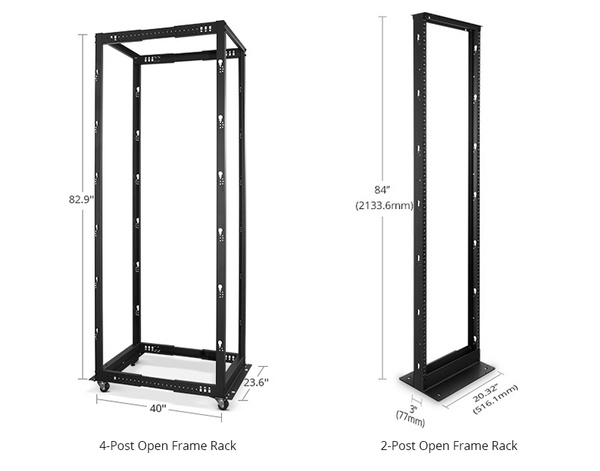
What is a server rack?
A server rack is an open-frame or enclosed structure engineered to mount and secure electronic equipment — typically standardized to accept 19-inch racks and rack-mountable devices. Height is measured in rack units (U) (1U = 1.75 inches), and depth/clearance must match the installed equipment. Racks use vertical rails and removable brackets to fasten devices; heavier items often need shelves or additional horizontal supports. Typical rack accessories include UPS systems, PDUs, cable management hardware, and fiber enclosures — all intended to keep a dense deployment clean and reliable.
Common types of data center server rack
Open server rack
An open server rack (open-frame) provides mounting rails without side panels or doors. These racks are cost-effective and allow free airflow from all directions, simplifying cooling and cable work. They’re ideal for wiring closets, labs, and spaces where physical security is not required. Two subtypes are common: 2-post (shallower, lighter loads) and 4-post (deeper, greater weight capacity).
Pros: lower price, easy access, excellent airflow, simple cable routing.
Cons: no physical security, greater dust exposure, usually bolted to the floor for stability.
Server rack cabinet (enclosed rack)
A server rack cabinet is an enclosed unit with front and rear doors, side panels, and adjustable vertical rails. Cabinets provide physical security (lockable doors and optional tinted glass), better cable concealment, and an organized appearance. However, because cabinets limit direct exposure to ambient air, you must plan ventilation and airflow management — perforated doors, blanking panels, and targeted fans are common options.
Wall mount server rack
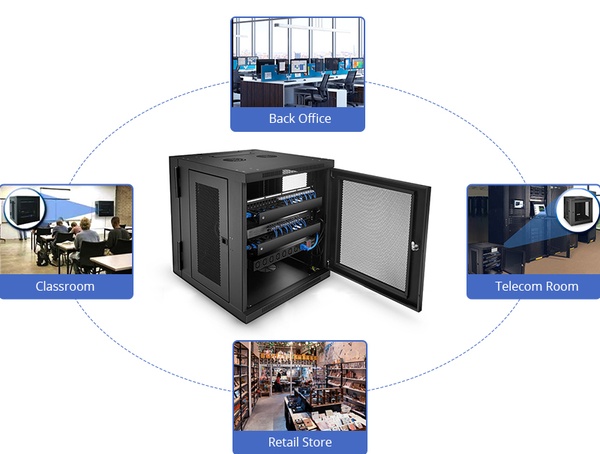
A wall mount server rack is designed to save floor space by mounting to a wall. Available in both open-frame and enclosed cabinet styles, these racks are useful for small offices, branch sites, or locations where a full-height rack won’t fit. They’re typically shallower and carry less weight, so they suit patch panels, small switches, and edge devices — not heavy server stacks.

Key buying factors (practical checklist)
When choosing a data center server rack, evaluate these critical aspects:
1. Size & form factor
Confirm the rack supports standard 19-inch equipment, choose the necessary height in U units, and verify depth for your deepest devices (switches, servers, PDUs). Typical full-size racks are 42U high, but many options exist.
2. Weight capacity
Plan for cumulative weight of servers, switches, batteries, and cable bundles. Overloading a rack risks failure and makes moving or reconfiguring equipment hazardous. Choose racks rated for the expected static and dynamic loads.
3. Cooling efficiency & airflow management
Cooling is a major cost driver in modern data centers. Select racks that support airflow management accessories (perforated doors, blanking panels, cable pass-throughs) and maintain proper hot-aisle / cold-aisle separation. Look for cabinets with at least ~64% door perforation or documented airflow specs when active cooling is required.
4. Cable management
Good cable management reduces heat, prevents accidental disconnections, and simplifies service. Search for racks with vertical/horizontal cable organizers, overhead or under-floor routing options, and space reserved for neat PDU/switch connections.
5. Security & access control
If equipment protection is required, prefer lockable rack cabinets with keyed or electronic locks and optional tamper detection. Tinted doors and side panels enhance privacy for sensitive installations.
6. Flexibility & manageability
Choose modular racks with adjustable rails, the option for casters (if mobility is needed), and enough spare U space for growth. Consider how easy it is to add shelves, rails, or airflow accessories later.
7. Installation & maintainability
Heavily shielded or thickly sheathed racks can be harder to terminate in the field. If technicians will frequently service the rack, pick solutions designed for quick access and standard terminations.
Quick comparison (when to pick which)
-
Choose an open server rack for low-cost, high-access needs where security and dust are minor concerns.
-
Choose a server rack cabinet when physical security, controlled airflow, and neat cable management are priorities.
-
Choose a wall mount server rack for small footprint installations and light network gear at the edge.
Summary
The right data center server rack improves protection, cooling, cable management, and power distribution. Match the rack type (open frame, enclosed cabinet, wall mount) and the rack’s size, weight capacity, cooling and security features to your current equipment and future growth plans. Thoughtful selection today reduces expensive rework later and helps keep the data center efficient and manageable.
We are an optical fiber manufacturer that produces optical fiber and optical cables, including indoor optical cables, outdoor optical cables, non-metallic optical cables, flame-retardant optical cables, bundled tube optical cables, ribbon optical cables, data center optical cables, underwater optical cables, submarine optical cables, optoelectronic composite optical cables, base station field optical cables, drone optical cables, and detection and sensing optical cables. The optical cables we produce are affordable. We also produce optical fiber supporting equipment, such as fiber optic splitters, multimode optical fibers, fiber optic connectors, fiber optic patch cords, fiber optic adapters, fiber optic splitters, Category 5, Category 6, and Category 7 network cables. We are an outdoor optical cable manufacturer, but we also wholesale computer room cabinets. If you would like to inquire about the price of computer room cabinets, please contact us. Computer room cabinet supplier
Some of our content is obtained from the Internet. If there is any inappropriateness, please contact us.